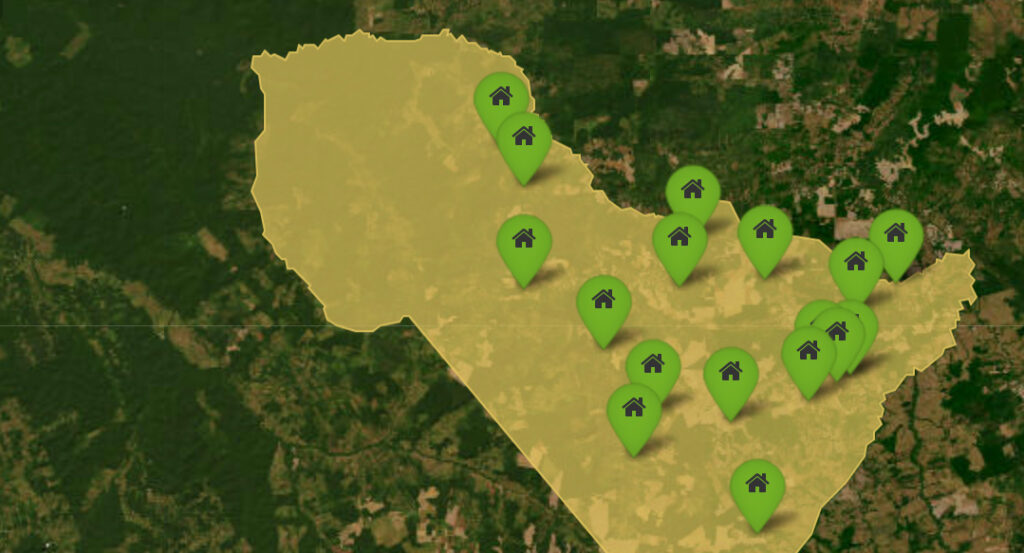
O IFD Map It is an interactive digital platform developed within the scope of the Paricá Program, resulting from a partnership between the Instituto Fronteiras do Desenvolvimento (IFD) and the ERM Foundation, with support from the Plataforma Parceiros pela Amazônia (PPA), Suzano, and the Alliance of Bioversity International and CIAT.
The platform was born from the need to make visible and connect those who produce, those who market, and those who support family farming in the territory of Dom Eliseu (PA). Its objectives are to strengthen cooperation networks, bring territories and markets closer together, and improve decision-making on territorial management.
The map compiles self-reported data from approximately 300 farming families and community organizations that participated in the Sustainable Network Project's diagnostic assessment. While it does not represent all existing initiatives in the municipality, the IFD Map offers a robust snapshot of the productive dynamics, territorial structures, and relationships that sustain life in the countryside.
The Sustainable Network project, which had the support of PPA (Partners for the Amazon Platform), strengthened family farming in southeastern Pará, connecting producers to private and institutional markets. The project also promoted the productive inclusion of young people and women through training and new commercial alliances.
The project addressed the main agroecological food chains in the Belém region and, together with local organizations, co-created guidelines for the fair and transparent marketing of these foods, as well as a platform with producer organizations from the state of Pará with the potential to supply COP30. It was carried out by the Institutos Fronteiras do Desenvolvimento and Regenera, with support from the Instituto Clima e Sociedade (iCS).
The Native Fruits project supported the conservation of the Atlantic Forest in the Paraíba Valley region by including native fruits in the school menu of the São Paulo state public school system. Conducted in conjunction with five municipalities in the state of São Paulo, the project promoted knowledge exchange and produced a publication to encourage the adoption of native fruits in the National School Feeding Program (PNAE). It was supported by TNC Brazil and carried out in partnership with the Fauser Institute, the Regenera Institute, and Mombora.
The project was developed between October and December 2020 and included the design, facilitation, and synthesis of multi-stakeholder dialogues to support Natura's advocacy strategy, within the context of the company's commitment to zero deforestation in the Amazon.