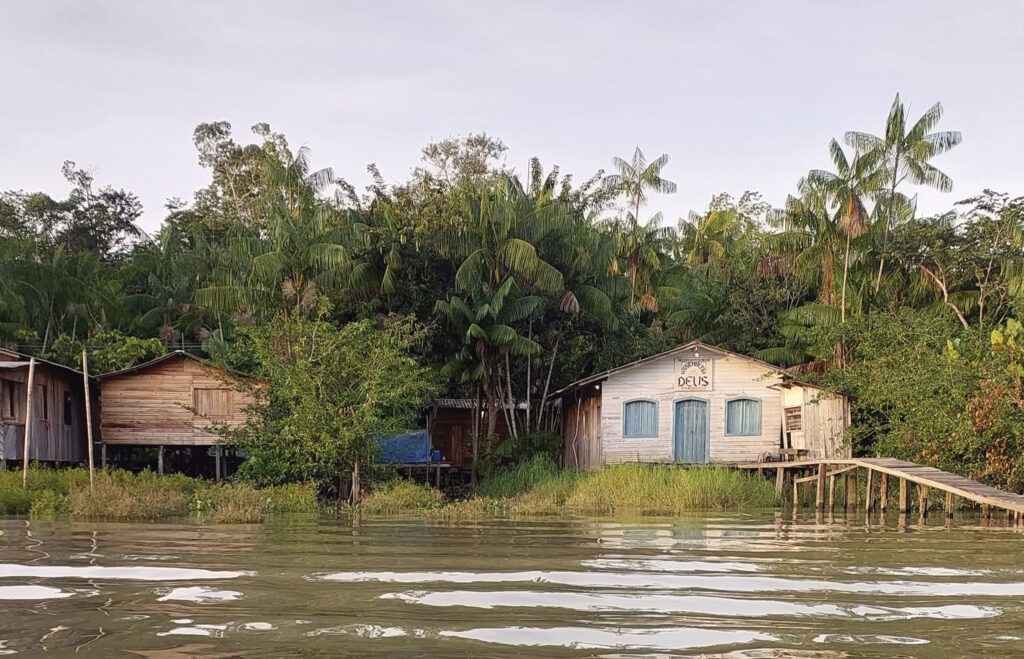
In the project From the Amazon to Belém, We support the expansion of the production and consumption of healthy and sustainable foods, such as agroecological and organic products, by strengthening the marketing link. With the support of iCS (Climate and Society Institute) and in partnership with the Regenera Institute, we developed the project over three stages, each lasting 12 months.
We identified the main challenges and opportunities in the territory related to the transition of agri-food systems and, together with local organizations in Belém, co-created guidelines for the fair and transparent marketing of these foods, with the aim of valuing productive practices that combat the climate crisis and support family farming and traditional communities. In this phase, we produced two publications.
In this second phase of the project From the Amazon to Belém, We implemented, together with four local organizations, guidelines for the fair and transparent marketing of agroecological foods, in a laboratory format.
The Laboratory was structured into six modules, covering the themes of management, governance, and communication. In each module, a practical project was developed to address an organizational need related to the theme.
Furthermore, we developed a methodology to assess the maturity level of organizations in relation to the six dimensions of fair trade. This methodology was applied to the group of organizations at the beginning of the project and again at the end of the Lab.
With the announcement that the UN Climate Conference (COP30) would be held in Belém in 2025, we undertook efforts to ensure that the food offered to delegations and participants from around the world would be locally produced, agroecological, and based on the socio-biodiversity of the Amazon.
The objectives of this third phase of the project From the Amazon to Belém Their objectives were to generate market opportunities for local family farming, to prove that there is sufficient production to supply large numbers of people, and to give visibility to sustainable food production models.
In this way, we seek to clarify the links between the food offered, who produces it, which communities benefit from it, and what the positive externalities of these foods are for the health of those who consume them, for the well-being of those who produce them, and for the challenges of adapting to and mitigating climate change.
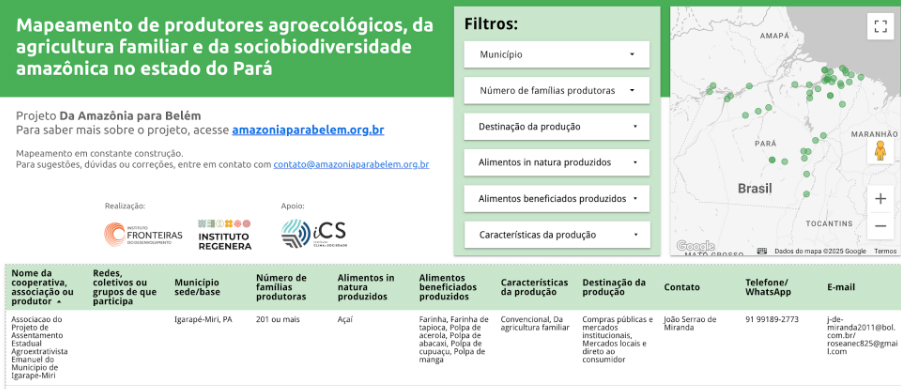
Within the scope of the project, activities focused on two fronts: coordination with the Federal Government and civil society organizations to ensure that this demand was met in the event's organization, and the mapping and qualification of cooperatives, associations, social movements, and producer networks capable of supplying COP30, consolidated in a public database.
The Sustainable Network project, which had the support of PPA (Partners for the Amazon Platform), strengthened family farming in southeastern Pará, connecting producers to private and institutional markets. The project also promoted the productive inclusion of young people and women through training and new commercial alliances.
IFD Map is a digital platform, the result of a partnership between the Instituto Fronteiras do Desenvolvimento (IFD) and the ERM Foundation. The platform was created out of the need to make visible and connect those who produce, those who market, and those who support family farming in the Dom Eliseu territory, in southeastern Pará.
The Native Fruits project supported the conservation of the Atlantic Forest in the Paraíba Valley region by including native fruits in the school menu of the São Paulo state public school system. Conducted in conjunction with five municipalities in the state of São Paulo, the project promoted knowledge exchange and produced a publication to encourage the adoption of native fruits in the National School Feeding Program (PNAE). It was supported by TNC Brazil and carried out in partnership with the Fauser Institute, the Regenera Institute, and Mombora.
The project was developed between October and December 2020 and included the design, facilitation, and synthesis of multi-stakeholder dialogues to support Natura's advocacy strategy, within the context of the company's commitment to zero deforestation in the Amazon.